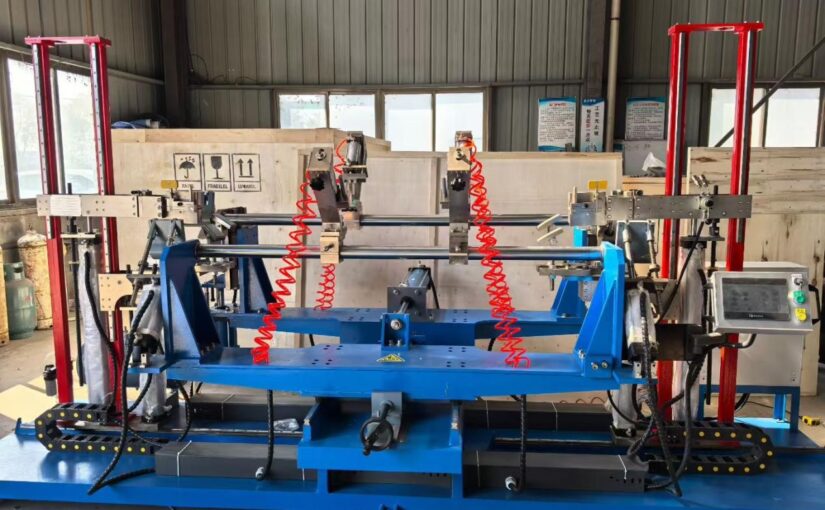
High voltage motors are essential in many industries where large amounts of mechanical power are needed for long periods. They are commonly used in power generation, water treatment, mining, oil and gas, steel production, chemical processing, cement manufacturing, and large industrial plants. Because these motors often operate under demanding conditions, their manufacturing requires much greater precision than that of many smaller electric motors. Every stage, from winding and insulation to rotor balancing and final testing, can influence the motor’s performance, efficiency, reliability, and service life.
Modern production equipment has changed how manufacturers approach this demanding process. A high voltage motor manufacturing machine can support accurate, repeatable operations that would be difficult to achieve consistently through manual work alone. Rather than replacing skilled technicians, advanced machinery helps them perform complex manufacturing tasks with greater control. This combination of engineering knowledge, specialised equipment, quality inspection, and careful process management allows manufacturers to produce motors that meet the requirements of modern industrial applications.
Why High Voltage Motor Manufacturing Requires Precision
High voltage motors are designed to handle electrical voltages and mechanical loads that place considerable demands on their components. The stator windings need appropriate insulation, the rotor must be mechanically balanced, and the magnetic circuit must be manufactured within suitable dimensional tolerances. Even relatively small manufacturing inconsistencies can affect vibration, temperature, electrical performance, or long-term reliability.
One of the most important areas is the stator winding system. High voltage motors generally require sophisticated insulation arrangements because the winding system must withstand the electrical stresses associated with high operating voltages. The conductors, insulation materials, winding arrangement, and connections all need to be prepared carefully. Manufacturing equipment can help control operations such as coil forming, winding, taping, inserting, and other preparation processes according to the motor’s design.
Mechanical accuracy is equally important. Components such as the stator core, rotor, shaft, bearings, and housing must work together correctly. If the rotor is not balanced properly, unwanted vibration can develop during operation. Excessive vibration may increase mechanical stress and contribute to premature wear of bearings and other components. Precision machining and balancing equipment therefore play an important role in producing motors that can operate smoothly.
Modern manufacturing also benefits from repeatability. A manually performed operation may vary slightly from one component to another, particularly when it involves a large number of repetitive tasks. Automated or semi-automated equipment can maintain more consistent operating parameters, reducing unnecessary variation between production batches.
How Modern Manufacturing Machines Improve the Production Process
A high voltage motor manufacturing machine is not normally a single machine that completes the entire motor. Instead, manufacturers use a range of specialised machines throughout different stages of production. Each piece of equipment is designed for a particular operation, and the machines work together as part of a controlled manufacturing process.
Winding equipment is one example. Depending on the motor design, specialised machinery can help form and position coils with controlled dimensions. Consistent coil geometry is important because the winding needs to fit correctly within the stator structure while maintaining the required electrical clearances and insulation arrangements. Automated winding systems can also provide repeatable tension and positioning, helping manufacturers maintain consistency during production.
Insulation processing is another area where specialised machinery can make a significant difference. High voltage insulation must be applied carefully, as weak points or inconsistent application can create electrical problems. Equipment used for taping, wrapping, pressing, curing, or related operations can provide more controlled processing conditions. However, the machine itself is only one part of quality assurance. Materials must also be selected correctly, stored properly, and processed according to their specified requirements.
Core assembly requires careful handling as well. The stator core is generally made from numerous laminated electrical steel sheets that form the magnetic path. Correct alignment and compression are important during assembly. Manufacturing equipment can help position and secure these components while reducing unnecessary manual handling. This can improve production consistency while also making the process easier to monitor.
Rotor manufacturing involves another set of challenges. Shafts and rotor components require accurate machining and assembly because the rotating assembly must maintain suitable geometry. Dynamic balancing equipment is particularly important for larger motors. During balancing, manufacturers can identify and correct uneven mass distribution so that the rotor runs more smoothly at operating speed.
Modern production lines may also use measurement systems and digital monitoring tools alongside conventional machinery. Sensors can record information such as temperature, pressure, rotational speed, winding parameters, or other process conditions. Recording these values gives engineers useful information for quality control and process improvement. If a recurring variation is identified, the production team can investigate its source instead of relying solely on visual inspection.
Quality Control Remains Central to Motor Manufacturing
Advanced machinery can improve manufacturing consistency, but it does not remove the need for detailed testing and inspection. High voltage motors are valuable industrial assets, and their reliability matters because an unexpected motor failure can interrupt an entire production process.
Electrical testing is therefore a critical part of manufacturing. Depending on the motor design and applicable standards, manufacturers may perform insulation resistance testing, winding resistance measurements, high-voltage withstand tests, surge-related testing, and other electrical checks. These tests provide information about the condition and performance of the electrical system before the motor is delivered.
Mechanical testing is also important. Vibration measurements can help identify problems with rotor balance, alignment, bearings, or other mechanical components. Noise, temperature, speed, and load behaviour may also be monitored during testing. The exact test programme depends on the motor’s specifications, intended application, and relevant industry requirements.
Dimensional inspection provides another layer of quality assurance. Precision measuring equipment can verify shaft dimensions, component tolerances, mounting arrangements, air gaps, and other critical characteristics. Maintaining accurate records of these measurements can help manufacturers identify trends and improve production processes over time.
This is where the relationship between machinery and skilled personnel becomes particularly important. A machine can repeat a programmed operation accurately, but engineers and technicians are responsible for selecting suitable parameters, interpreting test results, identifying abnormal conditions, and deciding whether a component meets the required specification.
Choosing Equipment for a Modern Production Facility
Manufacturers considering new machinery need to look beyond automation alone. The appropriate equipment depends on the type and size of motors being produced, expected production volumes, available floor space, component dimensions, workforce capabilities, and required quality standards.
Flexibility can be especially useful for manufacturers producing different motor models. Equipment that can accommodate a reasonable range of dimensions and winding configurations may reduce the need for separate production systems. At the same time, highly specialised equipment can be beneficial when a factory produces large quantities of a particular motor design.
Maintenance requirements should also be considered. Production equipment needs regular inspection, calibration, lubrication, component replacement, and software or control-system maintenance where applicable. A machine that is difficult to maintain can create avoidable downtime, even if its production capabilities are strong.
Training is another important consideration. Operators need to understand both the equipment and the manufacturing process. Proper training helps employees recognise abnormal machine behaviour, follow safety procedures, perform routine checks, and respond appropriately when production parameters move outside acceptable limits.
Safety must remain a priority throughout the facility. High voltage motor production involves heavy components, rotating machinery, electrical systems, insulation materials, heat, and potentially high stored energy. Appropriate guarding, isolation procedures, personal protective equipment, workplace training, and documented operating procedures are essential.
The Future of High Voltage Motor Production
The development of manufacturing technology is likely to continue changing how high voltage motors are produced. Digital monitoring, improved automation, machine vision, data collection, and more sophisticated control systems can give manufacturers better visibility over production processes.
Data-driven manufacturing can be particularly useful for identifying repeated defects or process variations. Instead of discovering a problem only during final testing, manufacturers may be able to identify unusual process conditions earlier. This can reduce material waste and make corrective action more straightforward.
Automation may also become more common for repetitive or physically demanding tasks. However, high voltage motor production is unlikely to become completely independent of human expertise. Complex engineering decisions, product development, testing, maintenance, and quality assessment still require experienced professionals.
The most practical approach is therefore to combine technology with skilled manufacturing teams. A well-selected high voltage motor manufacturing machine can improve repeatability and production control, while engineers and technicians ensure that the finished motor meets the technical requirements of its intended application.
Conclusion
Manufacturing high voltage motors is a detailed process in which electrical, mechanical, and material considerations must work together. Modern machinery can improve the consistency of winding, insulation processing, core assembly, machining, balancing, measurement, and other production stages. At the same time, testing and skilled inspection remain essential for confirming the quality of the finished product.
For manufacturers, investing in suitable equipment should be viewed as part of a wider production strategy rather than simply an attempt to increase automation. The right combination of reliable machinery, trained personnel, controlled processes, appropriate materials, and thorough testing can create a more consistent and efficient manufacturing environment. As industrial equipment continues to become more digitally connected and precise, these improvements can help manufacturers meet the growing technical demands placed on high voltage motors while maintaining practical standards for quality and reliability.